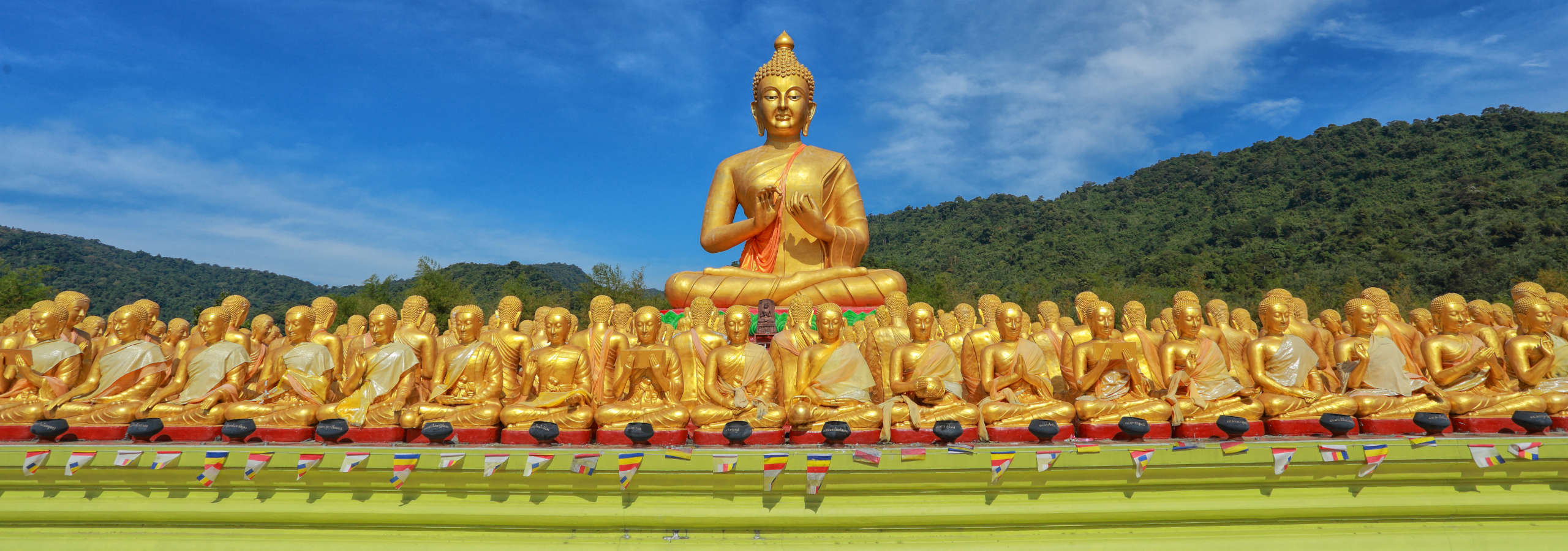
THAI BUDDHISM & TEMPLES
Thai Buddhism in Thailand: Beliefs, Temples and Important Buddhist Religious Days
Most Thai people are Theravaden Buddhists. Theravada (pronounced "terra-vah-dah") meaning "doctorine of the elders" is based on the earliest surviving record of the Buddha's teachings. Buddhism and Temples are an important aspect of Thai life.
Introduced to the region many centuries ago, Theravada Buddhism focuses on the teachings of the historical Buddha, Siddhartha Gautama, and places strong importance on personal discipline, wisdom, and compassion. In Thailand, Buddhism is not only a religion but also a way of life that influences customs, festivals, family values, art, education, and daily behavior. Images of the Buddha, offerings of flowers and incense, and visits to temples are all familiar parts of everyday life across the country.
The main beliefs of Thai Buddhism include the ideas of karma, rebirth, merit-making, and the path toward enlightenment. Karma teaches that a person’s actions shape their future experiences, while rebirth reflects the cycle of life, death, and being born again. Thai Buddhists believe that by living morally, showing kindness, controlling desire, and making merit through good deeds, they can improve their lives and move closer to nirvana, the end of suffering. Merit-making is especially important in Thailand and may include donating to temples, supporting monks, releasing animals, or taking part in religious ceremonies.
Thai Buddhist worship is centered around a variety of religious buildings, the most common being the temple, known in Thai as a wat. A wat is often a large temple complex made up of several important structures. These can include the ubosot, the ordination hall used for sacred ceremonies; the viharn, an assembly hall that often houses a Buddha image; the chedi or stupa, which may contain relics; and the sala, an open pavilion used for gatherings and community activities. Many temple grounds also include monk residences, bell towers, libraries for sacred texts, and cremation areas. These buildings are often richly decorated with gold, colored glass, carved wood, tiled roofs, and images from Buddhist stories.
Monks hold a highly respected place in Thai Buddhist society. Many Thai men traditionally spend some time as monks or novice monks, even if only for a short period, as a way to make merit for themselves and their families. Monks follow a strict code of conduct, live simply, and depend on the support of laypeople for food and daily needs. In return, they teach Buddhist principles, lead ceremonies, chant blessings, and provide spiritual guidance. Early each morning in many parts of Thailand, monks can be seen walking quietly through the streets to receive alms, an important tradition that reflects the close relationship between the monastic community and the public.
Important Buddhist dates in Thailand are observed according to the lunar calendar, so their exact dates change each year. Among the most significant are Makha Bucha, which commemorates a gathering of the Buddha’s disciples; Visakha Bucha, marking the Buddha’s birth, enlightenment, and death; and Asalha Bucha, which remembers his first sermon. Khao Phansa begins the three-month Buddhist Lent, when monks traditionally remain in their temples during the rainy season, while Ok Phansa marks its end. These holy days are often observed with temple visits, candlelit processions, prayers, offerings, and acts of merit. Together, these traditions show how deeply Buddhism remains woven into the spiritual identity and cultural life of Thailand.
Thai Buddhist Religious Days
- Makha Bucha Day
Tuesday, 3 March 2026
Observed on the full moon of the third lunar month in February.
A holy day commemorating the spontaneous gathering of 1,250 disciples to hear the Buddha’s teaching on avoiding evil, doing good, and purifying the mind. - Visakha Bucha Day
Sunday, 31 May 2026
Observed on the full moon of the sixth month of the lunar year, which is around the middle to end of May on the western calendar.
The most important Buddhist holy day, marking the birth, enlightenment, and passing away of the Buddha.
There is a nationwide ban on the sale of alcohol everywhere in Thailand during this period. - Asalha Bucha Day
Wednesday, 29 July 2026
Observed on the full moon of the eighth lunar month usually in July.
Observed as the day the Buddha gave his first sermon, beginning the formal teaching of Buddhism and the first appearance of the Sangha. - Khao Phansa - Buddhist Lent Day
Thursday, 30 July 2026
Observed on the first day after the full moon of the eighth lunar month which is usually July.
Marks the beginning of Buddhist Lent, when monks traditionally begin their three-month rainy-season retreat in the monastery. - Ok Phansa - End of Buddhist Lent
Monday, 26 October 2026
Observed on the full moon of the eleventh lunar month within October.
Marks the end of the three-month rains retreat and is associated with merit-making, temple visits, and post-Lent ceremonies. - Tod Kratin
Tuesday, 27 October 2026 to Wednesday, 25 November 2026
Held on one particular day chosen by the temple anywhere from the day after Ok Phansa through to the full moon of the twelfth lunar month
During this time most Buddhists take part in ceremonies. Robes and other necessities of temple life are offered ceremoniously to the monks on the appointed day.
It is also an important occasion for the temple to raise funds.

Chedi
The Chedi is also commonly called a Stupa. This sacred Buddhist monument is built to enshrine holy relics, memorial ashes, or objects of deep religious importance. Found within temple grounds across Thailand, the Chedi is one of the most recognizable features of Thai religious architecture. Many are covered in gold, white plaster, colorful tiles, or intricate decorative patterns which gives them a striking appearance.
Chedis come in many forms, from bell-shaped designs influenced by Sri Lankan Buddhism to slender, towering structures unique to Thai style. They are often surrounded by courtyards, Buddha images, incense burners, and places for prayer, making them important centers of devotion within a Wat. Visitors and worshippers may walk slowly and respectfully in a clockwise direction as an act of merit and reverence. Press the palms of each hand together in the Thai "Wai" style to the height of your face as an act of merit and reverence.

Chofa
This decorative ornament is found on the end of a Wat roof and symbolises the mythical creature Garuda.
The Chofa is most commonly seen on the gable peaks of Buddhist buildings such as Ubosots and Viharns. It is often shaped in a long, curved form that resembles the head of the Garuda. The chofa is usually finished with gold paint and decorative glass.
It is often associated with sacred symbolism and is thought to represent heavenly beings or mythological forms linked to Buddhist and Hindu influence in Thai culture.

Hor Rakang
The Hor Rakang is a bell tower within the grounds of a Buddhist temple for calling the monks and novices to perform morning and evening ceremonies.
These structures can range from simple wooden towers to beautifully decorated buildings with carved details, tiled roofs, and traditional Thai architectural features.
You will see the Hor Rakang standing alongside other important buildings such as the Ubosot, Viharn, and Chedi.
The ringing of the bell is often associated with mindfulness, reflection, and its elevated design helps the sound of the bell carry across the temple grounds.

Kuti
A Kuti is a small traditional wooden stilted dwelling to house a senior monk. Usually simple and modest in design, the Kuti reflects the Buddhist ideal of living with few possessions and without luxury. Each Kuti would stand in a more private and peaceful corner of the temple complex. This gives the monk a place for rest, study, and meditation. While some modern temples have more permanent concrete buildings, the purpose of the Kuti remains the same.
Most often there are also large shared quarters for the other monks and novices of the temple who are not provided individual dwellings.

Naga
The Naga is a serpent creature in Buddhist and Hindu mythology. They are most often found adorning the stairway entry to a temple. A typical naga would have a a multi-headed crest, scales, long curving bodies, and decorative details painted in bright green, gold and red. They are designed to appear fierce and act as protectors of the Buddha and the temple.
In Thailand, the Naga imagery also reflects older regional beliefs connected to water, fertility, and the natural world.

Prang
A Prang is built in the form of a spire. In Thailand the Prang originates from old Khmer architecture. Commonly found in the ancient city of Ayutthaya but the most famous Prang in Thailand is Wat Arun which is located on the banks of the Chao Phraya river in Bangkok. The photo here shows a Prang from Ayutthaya.

Ubosot
Commonly called a Bot or Ubosot. This is the hall where monks in Thailand get ordained and is also their main prayer room. Looking much like a Viharn but disquinguishable by the placement of Sema stones at the four corners of the building and the center of each wall of the building. A total of eight stones on the outside. A Ubosot may not be open to the public.

Viharn
Also spelt as Wiharn. The Viharn is more open to everyday religious activity by both monks and laypeople. It is where the local lay Buddhists gather together to pray, chant, and listen to teachings of the Buddha by the monks at particular times. The Viharn also serves as both a spiritual and communal space, where visitors and locals come to make offerings, light incense, and pay their respects to the Buddha.
A temple complex can have several Viharn. It is usually one of the main buildings in a Wat grounds and will house a large Buddha and smaller Buddha images inside.
Inside, the atmosphere is calm, reverent and often with rows of columns, polished floors, and murals showing scenes from the life of the Buddha.
One very important thing to remember if you visit is when you are sitting or kneeling, to never point your feet towards the Buddha image as this is very dis-respectful. Removal of shoes before entering the temple is also expected.

Wat
The Wat is the Thai name given to an entire temple complex in Thailand that serves as the spiritual heart of communities. The common types of buildings in a temple complex would be the Viharn, Phra Ubosot, Chedi, bell tower, Prang, monk residences, Ho Trai and Sala. Some temple complexes in rural areas may also have a regular school that teaches common educational subjects.
Thai people visit their local Wat regularly to make food offerings to the monks and seek blessings.
Monks living in the temple provide spiritual guidance, chanting and ceremonies, and preserve Buddhist teachings.
Yak
A Yak is a giant mythological guardian figure found inside some temple grounds. They can also be called a Yaksa. These fierce looking creatures in elaborate armor are the guardians of the gates. Yak figures are not to be confused with evil, they symbolize guardianship and are the protectors that stand watch over sacred places, helping guard the temple from harmful forces.