TRAVEL TIPS FOR VISITING THAILAND
Travel Tips for Trips To Thailand: What to Know Before You Go
Thailand's Electrical System
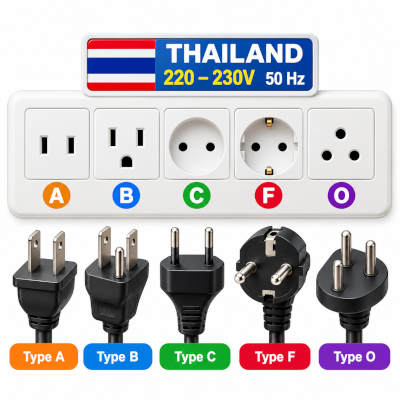
Thailand has a 220-230 voltage with 50Hz electrical system that can use five plug types of Type A, Type B, Type C, Type F, and it's own unique Type O. The common plug types you will find in Thailand are Type C and Type A.
You purchase the power adapter with a socket type to plug your device into, and with the other end with pins that match Thailand wall sockets. Buy an adapter that has a set of swappable pins to match at least the common C and A types for Thailand.
If you are from the United States, Canada, or Japan, then your system is 110 Volts at 60Hz, which will likely make your electrical equipment in Thailand non-compliant and dangerous to use if it is not dual-voltage and dual-Hertz sytem compatible.
You may find some hotels have multiple power outlets in the room or bathroom which are compatible with different countries, but you need to verify this when booking a room. Read the room facilities listing.
If you are taking any of your own electrical items then you must ensure they are compatible for voltage and Hertz frequency within it's operating range or it will be very dangerous to use them.
I suggest you buy hairdryers and kettles and other kitchen equipment in Thailand if needed. This type of equipment is very cheap in Thailand.
Most modern chargers for laptops, smatphones, and inbuilt battery shavers (not direct socket plugin unless dual range), may have a compatible voltage and herz range, but it's important to check. You then simply need to buy an adapter at an airport, luggage retailer, or electrical store.
A word of warning. Power lines in Thailand are often a tangled mess of wires between street poles and to buildings. Never touch poles or dangling lines, and be wary of where you walk so as not to tread on any fallen lines.
Power adapters for Thailand
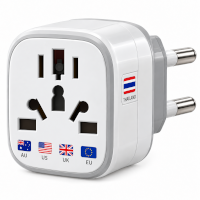
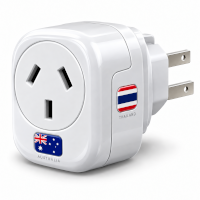
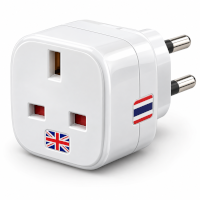
The power adapter you will need to purchase can be either one suited only for your country, or as depicted in the image, a universal one for several countries.
Best option is to buy one with a socket for your countries plug with different adapters for the various Thailand sockets. You may need to purchase from a store in Thailand to be able to get each Thai plug type if required.
These example adapters use either the common A or C type Thailand pins. Try and purchase a kit that you can swap out the Thailand pins to any of the 5 types.
IMPORTANT: Adapters DO NOT adjust for Voltage or Hertz. Your electrical device such as your shaver or charger MUST be compatible with 230 volt and 50Hz Thailand power, else it will be a fire and electrocution risk.
Plan before Departure to Thailand
Plan well beforehand prior to departure to make your Thailand vacation enjoyable. A plan also helps you stay on budget without feeling like you’re missing out.
Create a simple checklist with key destinations, a few must-do activities, and a couple of backup options for rainy days.
It also means you can prepare essential travel insurance, the right licence and permits if you’ll be driving, test the apps you’ll actually use, and order some Thai Baht for those immediate cash only situations such as a taxi ride once you arrive. You dont want to be wasting time scrambling to organize things at the last minute.
Below are a some tips on organizing your vacation. It would be best to visit your countries immigration website for notifications, warnings and advice on traveling in Thailand.
Visa and Entry Card for the Kingdom Of Thailand
Before entry you MUST complete an online Thailand Digital Arrival Card (TDAC) at least 3 days before arriving in Thailand. All travelers must now complete and submit this digital form before entering the country, regardless of their visa type or method of entry. This is NOT a Visa application, it is a digital arrival card.
Your passport must have at least 6 months validity remaining or you may be refused airline boarding in your country, or refused entry in Thailand at Thai immigration at the airport.
It is your responsibility to organize a visa to enter the Kingdom Of Thailand, if one is required. If your country is on the exemption list you will still be required to complete an online Thailand Digital Arrival Card (TDAC) before traveling to Thailand. Visa requirements can change at any time and it is also advisable to check with your countries immigration department as well as the official Thai immigration website.
Visit the THAI E-VISA OFFICIAL WEBSITE for all types of visa information. This site has a query tool that can determine your visa requirements and information on all the visa categories. There may also be vacination requirements, depending on your country of origin, or other current travel requirements.
A TM30 "place of stay" registration is also a requirement in Thailand for visiting foreigners. Your hotel or resort will usually do this automatically for you on arrival, but if you are staying with friends or other private accommodation then the house owner (housemaster or landlord) must complete this form.
There may be other requirements before entry, depending on what country you live in, so read the official Thai website carefully.
Safeguarding Passports
Make a few color photocopies of your passport with the page that has your photo and details. Keep it separate from where you store your passport.
Use these in the event you lose your passport and need to have another made at your countries embassy. It will save time and help prove your identity.
Your passport must be valid for at least 6 months and have some blank pages to allow a visa stamp upon entry.
It may be more secure for you to always carry passports around with you instead of storing in a hotel safe. Use a security body pouch. Technically, any Thai official, including the police can ask to see your passport at any time.
Please NEVER leave your passport for security for anything. It could be used to extort more money from you later. Simply show your passport and leave a photocopy with any scooter hire or car rental business etc. if they want one. Find another vendor if it is an issue.
Flying into Thailand
Suvarnabhumi (pronounced: soo-wun-a-poom) is the international airport for Thailand and is 25 kilometers (16 miles) east of Bangkok city center.
If you only have carry on luggage size then you can take the train to Bangkok using the MRT Skytrain located on the ground floor.
There are taxis outside from the arrivals floor. You should barter a fixed fare before loading any luggage in the taxi. Do not take any "private" taxi if you are approached by a stranger on the arrivals floor.
Busses also depart from the transport center and the prices are cheaper. They also go to destinations other than Bangkok. You will then need to organize transport from the city bus station to your hotel using a tuk-tuk, songthaew or taxi.
Don Muang Airport is the domestic airport for Bangkok located about kilometers (19 miles) north of Bangkok. But some airlines fly their domestic routes from Suvarnabhumi International airport.
Getting from Suvarnabhumi International Airport to Bangkok
Taxi: Located outside from the arrivals. There is toll way fees to pay (about 100 Baht) and you will need to give to the taxi driver.
Bus: Take the free shuttle bus to the transport station that is located away from the airport.
Train: Skytrain into Bangkok. Take the escalator to the underground level . Only if you have hand held luggage as the train is not intended for taking full size luggage.
See the Bangkok main transit hubs for more information.
Flying back home
Plan to arrive at Suvarnabhumi International Airport in Bangkok at least 3 hours prior to departure as this is a very busy and large airport and it will take an hour to check-in, an hour waiting to get through immigration and a half hour to locate your departure lounge. This gives you little time to spare, so make it 4 hours!
Show your flight ticket to an information booth after passing through immigration to receive a free wifi voucher. Don't forget to claim back any eligible VAT sales tax. See "Money and VAT" below.
If your flight is in the evening then take a taxi to Suvarnabhumi International Airport after hotel checkout with your luggage and deposit it into a luggage room (check open and closing times) which will not cost much. Take the Skytrain from the airport underground level back to Bangkok and spend the remaining few hours in the city before taking the Skytrain back to the airport to collect your luggage and check into your flight.
Do not take any unprocessed foods back home and be aware of your countries restrictions on food and other items entering through airports. Clean all shoes because some countries have regulations regarding mud and debris from rural areas throughout Asian countries bringing back unwanted agricultural diseases.
Bringing in money and claiming VAT refunds
Thailands' currency is the Thai Baht. The currency conversion rate from most western counties makes Thailand a popular destination for a vacation. If you eat and shop where the locals eat and shop, then your hard earned vacation money will go a long way.
Thailand remains very cash-centric, so always carry some cash. Street vendors, local markets, and smaller cafes often do not accept cards.
If you want to take advantage of the better exchange rates then take your countries bank notes into Thailand and exchange at a bank in the city. The airport exchange rates can be lower. Notes must be of a high denomination and be clean and crisp or you will probably get a lower rate or be politely refused any exchange. If you do the exchange at a bank, they likely will photocopy your notes to record the numbers.
Beware that your country will have restrictions on the amount of your currency that can be taken out without declaring it to your customs. Visit your immigration department website for details. You should keep a withdrawal receipt from your bank to prove to immigration where the cash originated.
There is no restriction of incoming foreign currency into Thailand, but an amount of, or equivalent of USD20,000 or more must be declared to a Thai customs officer. Source: Sawasdee Thailand Government Website.
There is a limit of Thai currency allowed when entering Thailand. Tourists may bring with them no more than 50,000 baht per person. Source: Sawasdee Thailand Government Website . You must provide proof of adequate finance of at least 10,000 baht per person, or 20,000 baht per family if immigration officials ask. Source: Sawasdee Thailand Government Website .
When you are flying back home you can claim the sales tax back on any items you have purchased on your vacation.
At Suvarnabhumi International Airport in Bangkok, the Valued Added Tax (VAT) refund claim is a two-stage process.
Before you check-in and before immigration you first need to go to the Customs VAT inspection counter in the departure hall and before you check in your luggage.
Present your passport and the VAT refund forms, original purchase receipts, and the actual goods to get your documents stamped by Customs. This step must be done before checking in and before passport control.
After you have gone through immigration and passport control and have entered the airport departure lounge, you will need to locate the VAT Refund for Tourists claim counters. You most likely will be lined up with many other people. It is advisable to arrive at the airport early. This is where you hand in your stamped forms and choose how you want the refund, either cash under a certain amount or card refund.
Using Credit Cards in Thailand
If you plan to use a credit card in Thailand then it is very advisable to inform your bank the dates you will be travelling and the main country you will be visiting. Your card may be "eaten" by an automatic bank teller machine if it thinks it is a fraudulent duplicate or a transaction could be refused when using a CC EFTPOS machine in a shop.
Take TWO credit cards from DIFFERENT banks if possible, in case one does not work or is lost or cancelled.
Keep your credit cards in an RFID blocking wallet/purse because credit cards can have a "tap and go" / "paywave" wire-less feature which can be fraudulently taken advantage of with illegal devices used by criminals stealing your details. Travel luggage shops and airport shops have these items for sale.
Check whenever a store clerk uses your credit card to swipe a machine that you actually receive the same card back after a sales transaction, that applies from anywhere in the world. If you always swipe the card yourself, then that would be a safer option.
Organising Travel Insurance before going
 Take photos of all your possessions and keep them on different peoples mobile phones. Travel apps where you can record everything is a good idea so you can prove to the insurance company and remember what to claim in the event of loss or damage. Check your travel insurance will cover your valuables because some have restrictions on the maximum claim amount per item, especially for electronic equipment such as cameras and jewellery.
Hospitals in Thailand are relatively cheap if you require a simple procedure such as cleaning and bandaging an abrasion after falling off a scooter but any major illness or bad accident will be expensive if major surgery and a prolonged stay is required. You will be stuck in Thailand if you cannot afford an emergency medical evacuation back home if your insurance does not cover this event. Take a paper copy of your travel insurance with the emergency contact number.
Be aware that any travel insurance possibly may not cover you for certain sports activities such as paragliding, parachuting, bungee jumping etc. Also, you will need to possess a motorbike licence from your country before you are covered for a scooter accident in Thailand (or any other country).
Creating a vacation Itinery
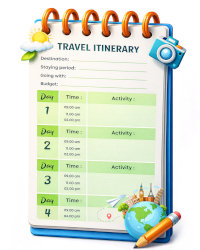
Create a detailed itinery of your flights, accommodation, train and bus routes and where you plan to visit. Make two copies and give a copy along with a copy of your travel insurance to a friend or relative that is not going with you to Thailand.
Upon entry to Thailand now, stricter rules are being enforced. An immigration officer may possibly ask you details on where you are going to visit and the places you are staying, so a detailed itinery would be ideal in this instance.
Your countries immigration service should also have a travel registration on-line service where you can provide contact numbers, addresses and emergency contact people in case your embassy needs to contact you if some unfortunate circumstance arises or you are in an area which requires evacuation.
Bringing in personal valuables

Like any other country in the world, you should take precautions with your valuables. Most hotels will have a security box in the room, but these are not very secure. A hotel safe to store valuables could be an option, but also at your own risk. You should record and insure all valuables with travel insurance but also store and hide valuables on yourself with money belts and securely strapped bags. Do not wear jewelry that would be easily snatched.
Thailand's Measurement System
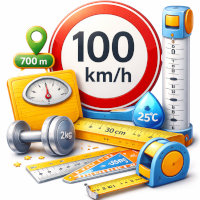
Just like most of the world, metric is the everyday measurement system used in Thailand.
Distances are measured in kilometres, speed in kilometres per hour, weight in grams and kilograms, volume in litres, and temperature in celsius. Road signs, fuel pumps, supermarket packaging, medical prescriptions, and weather reports all follow metric units, making it straightforward for visitors from metric-using countries.
There are many apps available for your mobile phone to convert metric to other measurement systems.
Languages in Thailand
English is spoken throughout Thailand and is taught as a major subject in Thai schools, so you should have no issue in major hotels and tourist areas if you speak English. A Thai phrase book with translations to your language and with Thai writing will be useful for elsewhere. There are apps for your smart device that can translate between many languages.
You could learn to speak some basic Thai words and phrases to be polite. This would mostly be appreciated by the locals. But, Thai words can have several different intonations, so pronouncing a word wrong can have a completely different meaning or not be understood at all. Read more and learning some common Thai words and phrases...
Roads and Self Driving
Traffic drives on the left side of the road throughout Thailand and there are local driving idiosyncrasies you should be aware of if you plan to self drive, such as scooters driving in dedicated lanes. Ask the car hire company about insurance options, tollways, and vehicle fuel type.
If you plan to drive in any mountainous areas of Thailand, then hire a high capacity diesel vehicle because a small city car will not make it up the steep roads, especially when full of people and luggage.
You will also need to have organized the correct driving permit before entering Thailand. If you are not from a metric system country, be aware that speed limits are in kilometers per hour and distances in kilometers, and fuel is measured in litres. Read more on self driving in Thailand.
Tipping
Tipping by tourists for services in Thailand is not normally done because you should barter a set price when taking a tuk-tuk, songthaew or taxi. A taxi may not want to use their meter but if you insist then they should comply. Exceptions can be to tip when you get a good massage and tip 50 or 100 baht directly to the person before you pay for the massage at the front counter because the person would be on a low commission rate. Small service tips for a hotel porter would also be a nice gesture.
Hotel taxis are expensive when you want to depart to the airport, so the taxi rank in the street would be cheaper, even with a tip added to the metered fare.
Thai Culture
Politeness by learning a few Thai words such as "Kob Khun Krup" (thank-you) will go a long way. Loudness of any kind is taken as aggressive behaviour and keeping "cool" in any situation is advisable. Learn a bit about Thai culture before travelling to Thailand as it is a very unique culture.
You could also learn some basic words and phrases in the Thai language before you go. Thailand also has a very unique and amazing cuisine, here are some popular food dishes.
Booking Accommodation
To get the best rate for hotels in Thailand always book on-line through a well known agency or through your travel agent. Walking into a hotel without a booking will incur a premium price! The highest cost factor besides the flight cost can be accommodation expenses and organising where you will stay in Thailand can be the difference between a cheap vacation and not so cheap. Dont forget to make two copies of your paid hotel vouchers and store each in different luggage. Without a printed voucher you may not be able to claim the discount accommodation at the hotel.
Food and Water safety
Street food and cafe style eateries is where you will see the locals eat. Thai food is cheap, tasty and usually safe just like any other country. My wife and I have never had a problem with the food in Thailand and the vendor will know to make your dish less spicy hot if you are a westerner. Some of the best food you can eat is from streetside vendors or some-one cooking home style food in the front of a small old cafe with basic tables and chairs. One great things about buying fruit in Thailand from roadside stalls and markets is that they are usually tree ripened and very sweet, full of flavor and cheap.
Water from taps / faucets / showers etc. is NOT safe to drink and should never be drunk under any circumstance. Boiling the water will NOT kill bacterial spores or botulinum neuro-toxins. Bottled water is very cheap in Thailand from the local shop if you purchase a cheap brand. If you cook food then ALWAYS use bottled water if required. Beware of ice in drinks if it is not from a safe source.
Health Check before you go

Visit your health professional at least 3 months prior to visiting Thailand because inoculations against some illnesses require injections over a period of time to be effective.
Your doctor will be aware of what is required. If you are visiting any rural areas in Thailand then you should declare what areas as this may affect what is required. You may want to carry antibiotics for food poisoning as a precaution.
If you take any restricted drugs, then you should obtain advice from your immigration department prior to departure and obtain a letter from your health professional. Always ensure all drugs have pharmacy labels with your name. You could carry the prescription with you to prove legitimacy.
Public Bathrooms in Thailand
Public bathrooms in Thailand at large service stations, shopping complexes, trains and large bus coaches, and tourist areas are usually very clean and some have attendants that charge a small fee. You can often purchase paper and toileteries at a cheap price from the attendant. You can usually find a western style toilet but it could be a squat toilet.
You should always carry toilet paper, soap, hand sanitizer and deoderizer if you intend to travel to rural areas, countryside markets, small towns and very cheap accommodation. But this would be normal no matter what country you visit in the world.
Using Mobile Cell Phones

Turn off your mobile cell phones "Mobile Data" option to avoid expensive overseas data costs. You can purchase a simm card and data plan in Thailand, or if you have a locked phone then buy a second hand phone in MBK in Bangkok.
Ensure your "Wireless" option is turned on to take advantage of free hotel Internet. Most hotels and other accommodation provide free wireless Internet connection, just ask for a voucher with the code and password.
Also very essential is to turn on "global roaming" for text and/or phone calls. This can usually be done on-line using your cell phone providers web site, or calling them before you depart. If you do not then you will need to use land line phones to call home, and no-body from home will be able to directly contact you in an emergency. Your mobile cell phone should be able to automatically connect to a preferred provider in Thailand, or you can select the recommended provider in Thailand in your cell phone options.
Here are few handy apps you could use on your mobile phone.
Using the Internet

Most hotels and other types of accommodation throughout Thailand have Internet available for tourists. Rural areas most likely will also have Internet coverage. You will also find Internet cafes are still a thing.
* Any advice in this article does not replace qualified expert advice that you should obtain prior to taking a vacation. Please read the full disclaimer.