WAT HUAI PLA KANG
Wat Huai Pla Kang : Chiang Rai’s Towering Guan Yin Temple
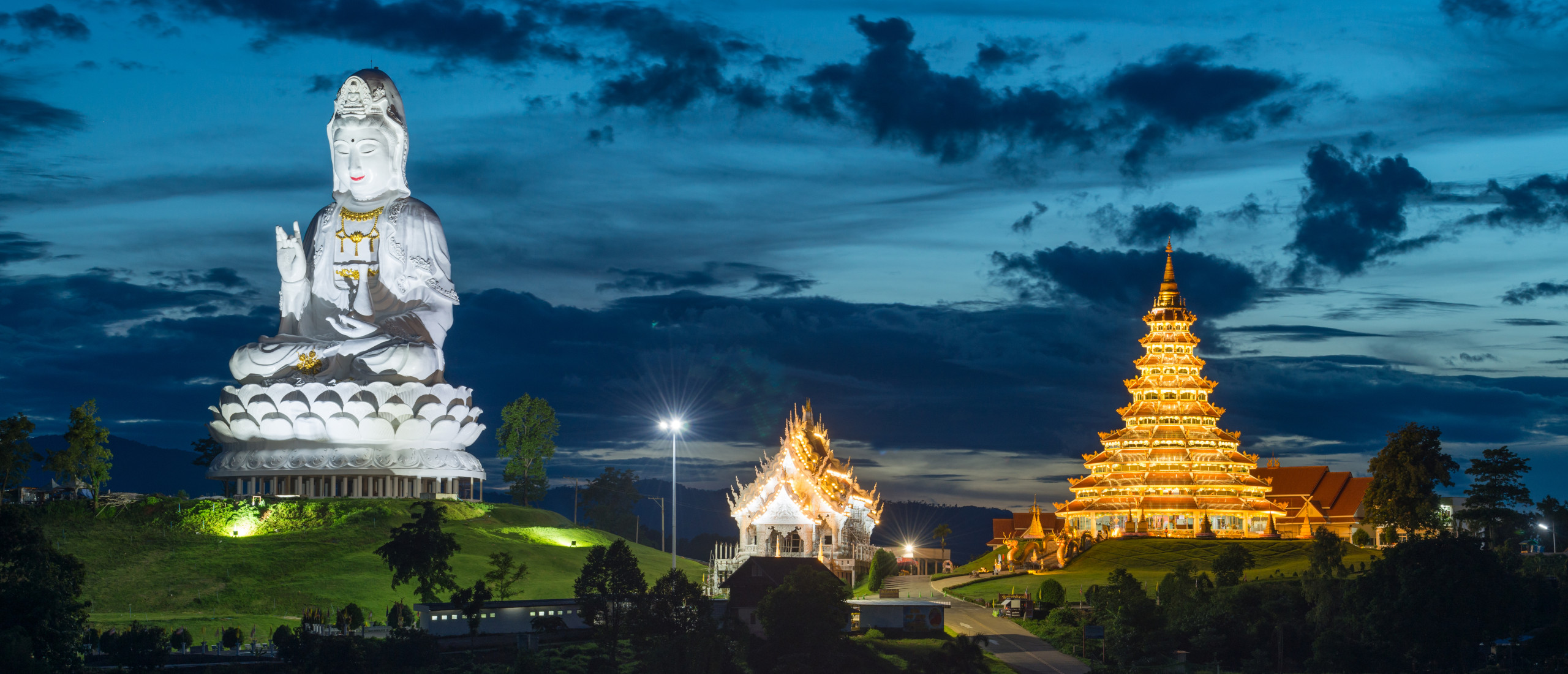
Wat Huai Pla Kang rises above the hills on the northern outskirts of Chiang Rai city and is one of the province’s most impressive religious landmarks. The temple complex is best known for its enormous white Guan Yin statue that can be seen from a considerable distance overlooking the surrounding countryside.
This monument is frequently called Chiang Rai’s “Big Buddha” although it does not represent the historical Buddha. It depicts Guan Yin who is the Bodhisattva of Compassion and is commonly known as the Goddess of Mercy.
The complex also contains a colorful nine-storey pagoda and an elaborate white prayer hall decorated with dragons, sculpted reliefs and fine ornamental details. Together, the buildings combine Chinese Buddhist influences with traditional northern Thai and Lanna-style architecture, giving the temple a character quite different from Chiang Rai’s famous White, Blue, and Red temples.
Another major attraction is the unusual nine-storey pagoda, sometimes known as the Phop Chok Dhamma Chedi. Its broad, tiered shape, red roof sections and golden edges make it one of the most distinctive buildings in Chiang Rai. Inside the pagoda is an impressive wooden image of Guan Yin surrounded by other religious figures. Different levels contain Buddha images, statues of respected monks and other Buddhist artwork. The upper levels have elevated views of the temple grounds but access is not always possible.
Standing near the pagoda is the beautifully decorated white prayer hall with its elaborate roof, sculpted exterior and naga-style dragon staircase. Inside the hall the color scheme remains mostly white and with a large white gleaming Buddha image surrounded by decorative columns. There will be people praying in front. Any photos you take inside should not include worshipers faces, and avoid using a flash.
Photography is generally welcomed around the exterior grounds, but please pay attention to signs inside religious buildings and avoid using flash near worshippers.
Do not stand directly in front of someone who is praying. A wide angle camera lens or wide setting on a mobile phone camera is recommended because you will be struggling to get everything into view in a single image.
In the evening the temple, pagoda, and Guan Yin monument are all illuminated which creates an incredibly striking scene. Viewed from a distance against the backdrop of the mountains the entire complex looks especially impressive. Taking photos will require a longer exposure time, so a camera/mobile phone tripod or some means of keeping still is essential for a great photo. Smart mobile phone cameras can often compensate for some movement. Because of the huge exposure range difference between the lit up buildings and surrounds, use your smartphone camera "night" setting if available, or HDR (series) setting for SLR cameras. This feature takes multiple exposure compensated shots and then combines them to make an improved image. The cameras matrix metering setting should also be on to evaluate the entire scene. Turn off the flash as it will have no effect on such an open and wide dark area and you don't want to light up any close-by unwanted objects in the foreground, although night settings will normally turn it off automatically.
Best time to start your visit to Wat Huai Plakang and Guan Yin monument would be during a week day and in the morning on a clear day so as to avoid the crowds and to get a clear sky before any haze build-up. Expect to stay 2 hours or more to see everything and locate vantage points for photos. December and January are the best months because towards March there is the usual crop burn-off in northern regions which creates significant haze.
See below for map and directions to Wat Huai Plakang.
Wat Huai Pla Kang



How To Get To Wat Huai Pla Kang
Wat Huai Pla Kang is situated north of the Kok River, approximately 15 to 20 minutes by road from central Chiang Rai under normal traffic conditions.
A taxi, private car using the Grap App, or organised tour provides the easiest transport. Many Chiang Rai sightseeing tours combine the temple with Wat Rong Khun, Wat Rong Suea Ten and other major attractions.
See the interactive map below for exact location.